Are Blockchain security breaches avoidable

The advent of blockchain technology promised a new era of decentralized trust and unparalleled security. Hailed for its cryptographic underpinnings and immutable ledger, many believed it was an unassailable fortress, impervious to the cyber threats plaguing traditional systems. However, the burgeoning ecosystem of cryptocurrencies, DeFi protocols, and NFTs has painted a different picture, one punctuated by a sobering reality: Blockchain security breaches are not only possible but have become an increasingly common and costly occurrence. From sophisticated smart contract exploits to fundamental design vulnerabilities, these incidents challenge the very notion of blockchain's inherent invulnerability, prompting a critical examination of whether these breaches are truly unavoidable.
The decentralized nature that grants blockchain its resilience also introduces unique attack vectors that differ significantly from those targeting centralized databases. While the blockchain itself, in its purest form, might be incredibly difficult to alter, the applications built on top of it, the bridges connecting different chains, and the human elements interacting with these systems present myriad points of vulnerability. Understanding these nuances is crucial for anyone engaging with blockchain, whether as a developer, investor, or user.
This raises a fundamental question: given the relentless pace of innovation and the ingenuity of malicious actors, can we truly shield blockchain systems from compromise? Or are these breaches an inherent, albeit manageable, risk of pioneering a new digital frontier? This article delves into the common causes, devastating impacts, and, most importantly, the proactive and reactive measures that can significantly reduce the likelihood and severity of security incidents within the blockchain space.
The Myth of Impenetrability: Why Blockchain Isn't Unhackable
While a fully decentralized, public blockchain like Bitcoin or Ethereum's core protocol is incredibly resilient to direct tampering, the broader blockchain ecosystem is far from impenetrable. The common misconception stems from conflating the immutability of the distributed ledger with the security of the entire application layer built upon it. The blockchain itself might resist a direct hack, but the interfaces, smart contracts, and off-chain components that interact with it are often ripe for exploitation. This distinction is critical in understanding why blockchain security breaches continue to plague the industry.
True immutability applies to transactions once they are confirmed and added to the chain. However, this does not mean that the smart contracts governing assets, the wallets holding private keys, or the oracles feeding external data are equally secure. The complexity introduced by these layers creates new surfaces for attack, requiring a multi-faceted approach to security that goes far beyond the cryptographic strength of the underlying ledger.
Common Vectors for Blockchain Security Breaches
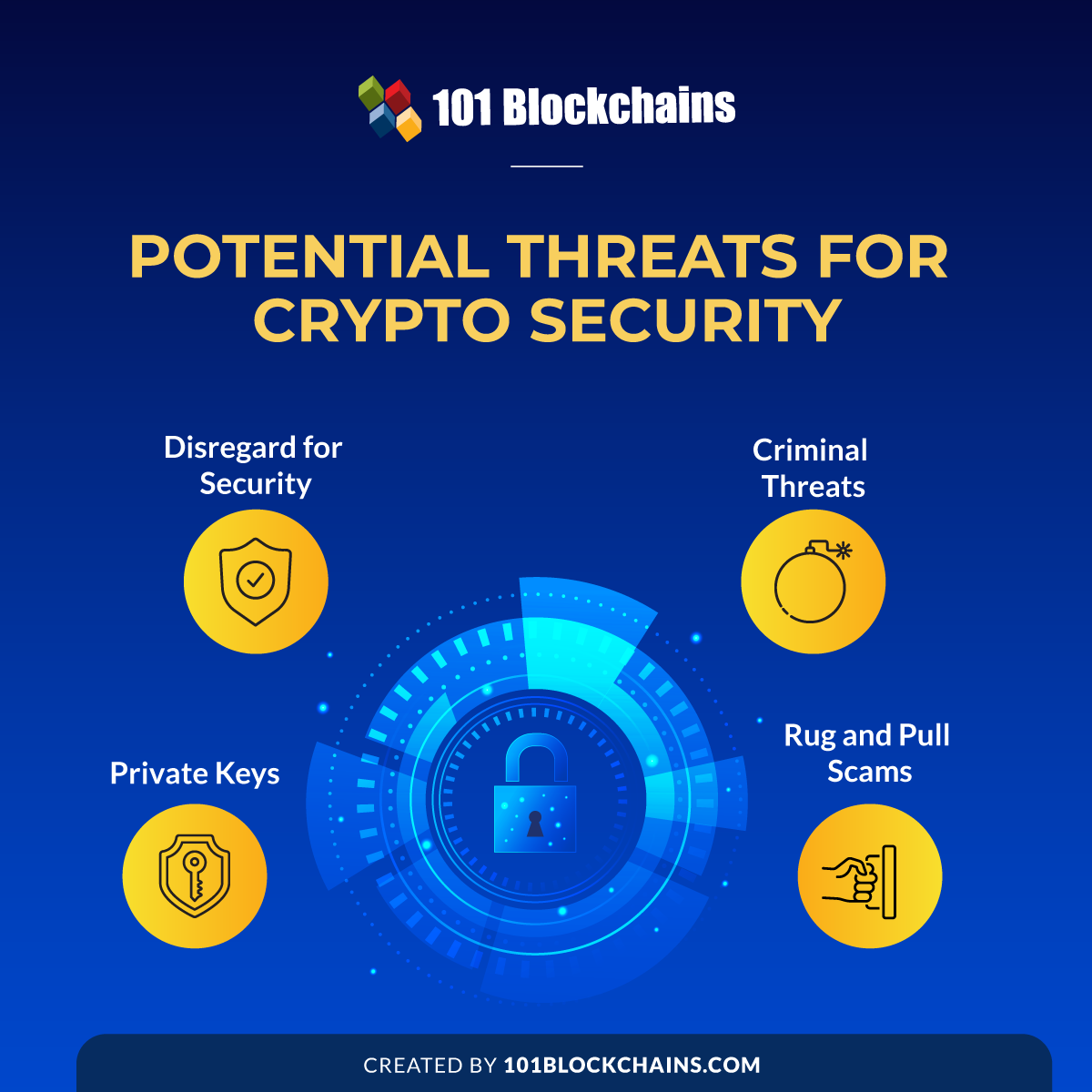
The landscape of blockchain security breaches is diverse, encompassing a range of sophisticated attack methods that target different layers of the ecosystem. Understanding these vectors is the first step toward effective prevention.
Smart Contract Vulnerabilities
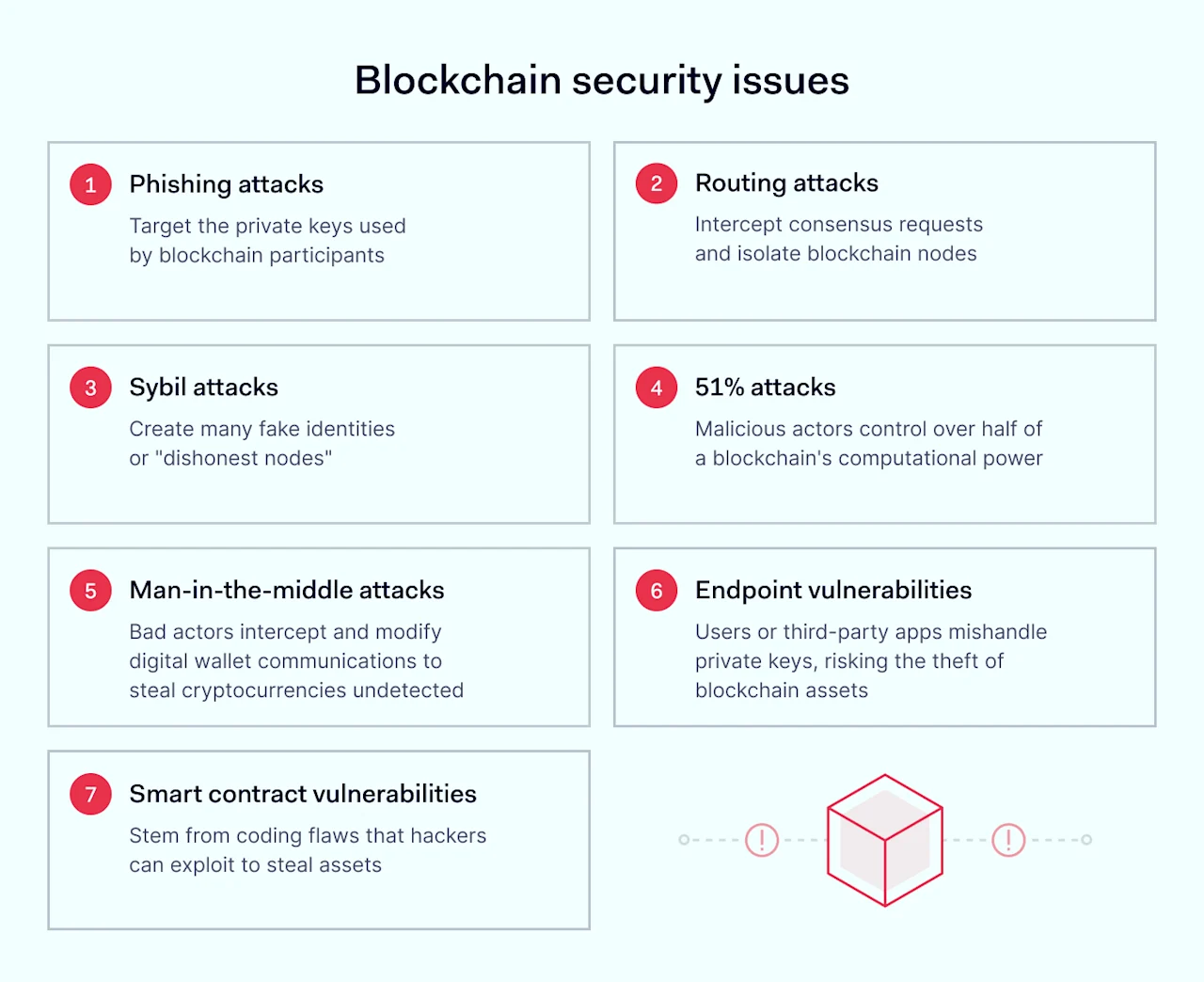
Smart contracts are self-executing contracts with the terms of the agreement directly written into lines of code. Their immutability, a core strength, becomes a critical weakness if the code contains bugs or logical flaws. Once deployed, a flawed contract is extremely difficult, if not impossible, to patch without complex migration strategies. Common smart contract vulnerabilities include reentrancy attacks, integer overflows/underflows, access control issues, logic errors, and denial-of-service vectors. An attacker can exploit these flaws to drain funds, manipulate protocol logic, or freeze assets.
51% Attacks
A 51% attack, also known as a majority attack, occurs when a single entity or group controls more than half of a blockchain network's mining or staking hash rate. This control allows them to manipulate the order of transactions, censor transactions, and even reverse previously confirmed transactions (double-spending). While highly impractical for large, well-established blockchains like Bitcoin or Ethereum due to their immense distributed hash power, smaller, less decentralized proof-of-work (PoW) chains remain susceptible.
Private Key Compromise
The security of a user's digital assets on a blockchain hinges entirely on the secrecy and integrity of their private keys. If a private key is stolen, lost, or compromised through phishing, malware, or insecure storage, the associated assets can be irrevocably lost. This is not a direct blockchain hack but rather a compromise of the user's interface to the blockchain, yet it accounts for a significant portion of asset losses. Centralized exchanges or custodial services that manage private keys on behalf of users are also prime targets for breaches, as a single successful attack can expose millions of users' funds.
Bridge Exploits
Cross-chain bridges allow assets and data to move between different blockchain networks. These bridges are often complex smart contracts or centralized entities that hold significant amounts of locked value, making them attractive targets for attackers. Vulnerabilities in bridge smart contracts, reliance on centralized oracles, or insecure signing mechanisms have led to some of the largest blockchain security breaches, resulting in hundreds of millions of dollars in losses.
Oracle Manipulation
Blockchains often need real-world data (e.g., asset prices, event outcomes) to execute smart contracts. Oracles are services that feed this external data onto the blockchain. If an oracle is compromised or feeds malicious/inaccurate data, smart contracts relying on that data can be exploited. For instance, a DeFi lending protocol might liquidate collateral incorrectly if manipulated price feeds are supplied by a compromised oracle.
Front-Running and MEV (Miner Extractable Value)
Front-running occurs when a miner or validator, observing a pending transaction, places their own transaction ahead of it to profit from the information. MEV is a broader concept where miners/validators can extract value by arbitrarily including, excluding, or reordering transactions within a block. While not always considered a "breach" in the traditional sense of a system compromise, it can lead to economic losses for users and distort market fairness.
Impact and Consequences of Blockchain Security Incidents
The repercussions of blockchain security breaches extend far beyond the immediate financial losses. While the monetary figures, often in the millions or even billions of dollars, capture headlines, the damage to trust, reputation, and the broader ecosystem can be far more enduring.
For individual users and investors, a breach can mean the total and irreversible loss of their digital assets, often with little recourse for recovery. Unlike traditional financial institutions with deposit insurance, the decentralized nature of blockchain means there is no central authority to compensate victims.
For projects and protocols, a significant breach can be catastrophic. It can lead to a complete loss of user trust, a plummet in the value of associated tokens, and even the demise of the project itself. Regulatory scrutiny often increases in the wake of major incidents, potentially leading to more stringent compliance requirements and a less favorable operating environment for the entire industry. Moreover, the "contagion effect" of a major exploit can impact interconnected protocols and the overall market sentiment, leading to wider economic downturns within the crypto space.
Proactive Measures to Mitigate Blockchain Security Risks
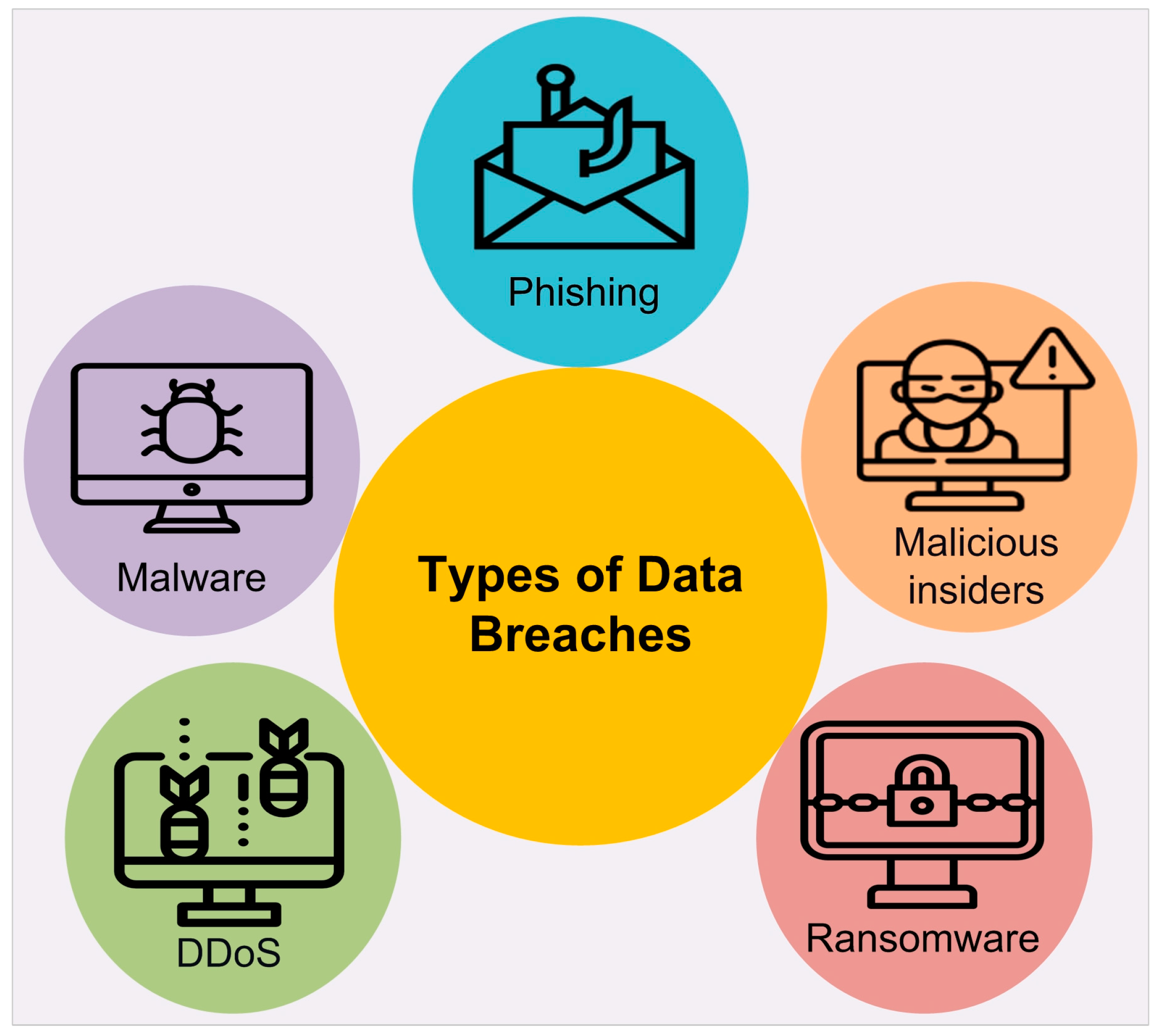
While the complete elimination of blockchain security breaches might be an elusive goal, their avoidance is largely achievable through a rigorous, multi-layered approach to security. The emphasis must shift from reactive responses to proactive defense mechanisms woven into every stage of development and operation.
Robust Auditing and Formal Verification
Before deploying any smart contract or protocol, it is imperative to undergo comprehensive security audits by reputable, independent firms. These audits identify vulnerabilities, logical flaws, and potential attack vectors. Beyond traditional auditing, formal verification applies mathematical proofs to confirm that a smart contract behaves exactly as intended under all possible conditions, significantly reducing the likelihood of critical bugs. While costly, these measures are invaluable investments.
Decentralized Oracle Solutions
To combat oracle manipulation, projects should prioritize using decentralized oracle networks (DONs) like Chainlink. These networks source data from multiple independent nodes and aggregate it, making it significantly harder for a single entity to corrupt thedata feed. Multiple redundant data sources and robust data validation mechanisms are key.
Multi-Signature Wallets and Hardware Security Modules (HSMs)
For managing project treasuries, multi-signature (multisig) wallets are essential. These require multiple private key holders to sign off on a transaction, preventing a single point of failure or compromise. For individual users, hardware wallets (HSMs) offer the highest level of private key security by storing keys offline and requiring physical confirmation for transactions. Custodial services should implement advanced HSMs and robust key management practices.
Community Vigilance and Bug Bounties
Leveraging the collective intelligence of the blockchain community is a powerful security tool. Establishing bug bounty programs incentivizes ethical hackers to discover and responsibly disclose vulnerabilities before malicious actors can exploit them. Transparent communication channels and active community engagement can also help surface potential issues early.
Secure Development Practices (DevSecOps)
Security must be integrated into every phase of the development lifecycle, not as an afterthought. This includes writing secure code, implementing secure coding standards, conducting regular penetration testing, and performing continuous monitoring of deployed systems. Teams should adopt a security-first mindset, prioritizing resilience and redundancy.
Incident Response Planning
Despite the best preventative measures, breaches can still occur. Having a well-defined incident response plan is crucial. This plan should outline clear steps for detection, containment, eradication, recovery, and post-mortem analysis. Rapid response can significantly limit damage and help restore trust.
The Evolving Threat Landscape: Staying Ahead of Blockchain Security Breaches
The cat-and-mouse game between innovators and attackers is constant in the blockchain space. As new technologies emerge, so do new attack vectors. For instance, the rise of rollups and Layer 2 solutions introduces new bridging complexities, while zero-knowledge proofs and homomorphic encryption present their own unique security considerations.
Staying ahead requires continuous learning, adaptation, and collaboration. Security researchers must constantly analyze past exploits to learn from them, developers must embrace new security paradigms, and the community must remain vigilant. Sharing threat intelligence, collaborating on open-source security tools, and fostering a culture of security awareness are paramount. Regulatory bodies are also increasingly engaging with blockchain security, which, while sometimes perceived as a burden, can also drive better practices and greater accountability across the industry.
Conclusion
The question of whether blockchain security breaches are avoidable is complex, but the answer leans heavily towards yes, or at least, significantly mitigable. While the underlying blockchain ledger itself boasts remarkable immutability, the applications, protocols, and human elements interacting with it introduce substantial vulnerabilities. The numerous high-profile incidents serve as stark reminders that security is not an inherent feature of simply using blockchain but a continuous, active process of design, implementation, and maintenance.
Achieving a high degree of security requires a holistic strategy encompassing robust smart contract auditing and formal verification, the adoption of decentralized infrastructure for critical components like oracles, stringent private key management, and a commitment to secure development practices from inception. Community engagement through bug bounties and a proactive approach to incident response further strengthen the ecosystem's defenses. Ultimately, while the threat landscape will continue to evolve, continuous vigilance, investment in cutting-edge security measures, and a collaborative industry effort can dramatically reduce the occurrence and impact of blockchain security breaches, paving the way for a more secure and trustworthy decentralized future.